How to Find the Right Foundation Shade for Your Skin Tone
Foundation is the product most capable of either making or ruining the rest of your makeup. When the shade is right, it disappears into the skin and everything built on top of it looks intentional and polished. When it is wrong, even a perfectly applied eye or lip draws attention back to the mismatch between the face and the neck. It is the one product where getting it slightly wrong is more visible than getting anything else slightly wrong.
The challenge is that finding the right foundation shade is genuinely difficult. Bottle colours in store lighting look nothing like what they look like on skin. What looks like a close match in the tube can look completely different once the formula interacts with your skin's natural oils and undertones. Most people have ended up with a collection of almost-right shades that sit unused precisely because foundation is so easy to get slightly wrong.
Quick Answer: Finding the right foundation shade requires matching two things: your depth (how light or dark your skin is) and your undertone (whether your skin has warm, cool, or neutral tones beneath the surface). Test shades on your jawline in natural light and choose the one that disappears. A perfect match looks invisible on the skin rather than like a visible layer.
Understanding Depth and Undertone
Depth is the dimension most people focus on first, and it is the most obvious: fair, light, medium, tan, deep. But depth alone is not enough, because two people with the same depth can have completely different undertones, and a foundation that matches one will look wrong on the other even if the shade looks identical in the bottle.
Undertone is the subtle warmth, coolness, or neutrality beneath the surface of the skin. It does not change with a tan or fade in winter the way surface colour does. The three broad categories are warm (golden, peachy, or yellow tones), cool (pink, red, or blue tones), and neutral (a mix of both). Identifying your undertone is one of the most useful things you can do before buying any foundation.
A simple way to assess undertone is to look at the veins on the inside of your wrist in natural light. Green or olive-toned veins generally suggest warm undertones. Blue or purple veins suggest cool undertones. A mix of both suggests neutral. Jewellery can also be a guide: people with warm undertones typically find gold jewellery more flattering and people with cool undertones find silver more complementary.
How to Test Foundation Shades Correctly
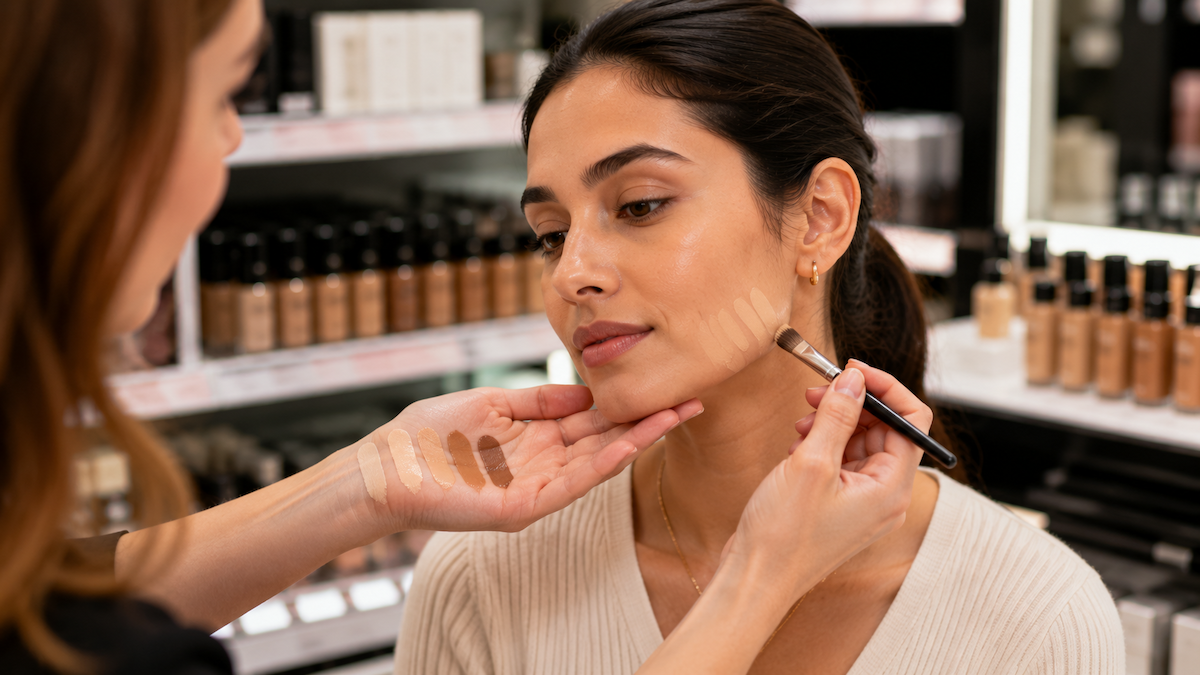
The biggest mistake in testing foundation is swatching it on the back of the hand or the inside of the wrist. The skin on those areas is often a very different colour from the face, and they receive different amounts of sun exposure, making them unreliable comparison points. Foundation should always be tested on the jawline, specifically on the transition between the face and the neck.
The goal is a shade that blends into the jawline without leaving a visible line. If you can see where the foundation ends and the neck begins, the shade is wrong. If the foundation matches your face but not your neck, you will have a floating face problem. The jawline test is the only reliable way to confirm a match.
Test in natural light whenever possible. Store lighting is notoriously warm or cool in ways that make shades appear different from how they look outside. If possible, step outside or near a window after applying a swatch to see the true colour. Allow the formula two minutes to oxidise and settle before making a judgement: some formulas shift colour slightly after initial application.
The Oxidation Problem
Many foundations oxidise, meaning they darken slightly on the skin in the first ten to fifteen minutes after application. If you test a shade and it looks perfect immediately, then looks slightly darker or more orange after a few minutes, that formula is oxidising on your skin. This is particularly common with formulas that contain high amounts of iron oxides or in people with more acidic skin chemistry.
The practical solution is to test a shade, wait fifteen minutes, then reassess. If it has shifted noticeably, try the shade one step lighter rather than the exact colour match that looked right initially. Many people who have struggled to find their foundation shade for years have simply been accounting for this oxidation without knowing to do so.
Coverage, Finish, and Formula Considerations
Once the shade question is solved, coverage and finish are the next decisions. Sheer coverage works well for skin that is already fairly even. Medium coverage suits most skin types and provides the most flexibility. Full coverage suits skin with significant discolouration, scarring, or conditions like rosacea where a stronger base layer makes a meaningful difference.
Finish refers to how the foundation looks once it dries. Matte finishes control shine and suit oilier skin types. Satin or natural finishes suit most people. Dewy or luminous finishes suit drier skin types and give a more radiant effect. The finish also interacts with other products: applying a setting powder over a dewy foundation pulls it back toward a satin finish.
The foundation range in the cosmetics section at Ross Highland Park includes brands like EltaMD and Revision Skincare whose foundations are formulated to work with rather than against the skin, offering shade ranges that account for real-world undertone variety.
Common Foundation Mistakes to Avoid
Buying a shade to match your summer tan and wearing it in winter is one of the most common foundation errors. Foundation should match your skin right now, not your skin at its most tanned. Having two shades and blending them seasonally, or updating when your colour changes significantly, produces better results year-round.
Going a shade lighter to achieve a brighter look typically produces the opposite: a greyish or ashy tone that is more visible, not less. If you want a brighter look, that comes from skincare, highlighter, or a foundation with a more luminous finish rather than an incorrect shade.
Not blending foundation down the neck and onto the chest when wearing lower necklines creates a visible contrast that draws attention to the mismatch. If you use foundation on your face, blending a small amount down onto the neck before it dries creates a seamless finish.
Frequently Asked Questions
Should my foundation match my face or my neck?
Your neck and face should ideally be close enough in colour that a single shade works for both. If they are noticeably different, choose a shade that splits the difference rather than matching either perfectly. Alternatively, find the face shade first and then use bronzer to blend the transition at the jaw.
What does it mean when foundation looks cakey?
Cakey foundation is usually caused by one of three things: too much product applied at once, dry or flaky skin that should have been better prepared, or a formula that does not suit the skin type. Applying thinner layers, prepping skin well, and choosing a formula suited to your skin type all help.
How do I know if my foundation shade has oxidised too much on me?
If your foundation looks noticeably darker or more orange than it did when you first applied it, it is oxidising. Try the shade one step lighter as a starting point. Some people find that applying a mattifying primer under foundation reduces oxidation by creating a barrier between the formula and skin oils.
Can I mix two foundation shades to get a better match?
Yes, and this is a common professional technique. Mixing a shade slightly too warm with one slightly too cool, or a too-light shade with a too-dark one, often produces a more precise match than either alone. A foundation mixing palette or simply dotting both onto the back of the hand before applying works well.
How much foundation should I actually use?
For most people, one pump or a pea-sized amount is sufficient for the full face when applied correctly. Starting with less and building where needed produces a more natural and longer-lasting result than applying a heavy layer all at once.
The Bottom Line
Finding the right foundation shade is a matter of understanding your undertone, testing on the jawline in natural light, and accounting for how a formula behaves on your skin over time. Getting this one decision right transforms how the rest of your makeup sits and how long it lasts.
Ross Highland Park carries a curated selection of foundations in the cosmetics section, with knowledgeable staff who can help you find your exact match. Stop in and take the guesswork out of one of beauty's most important decisions.