How to Maintain Curly Hair Between Salon Visits
Curly hair has a reputation for being high-maintenance, and to a point that reputation is earned. Curls require more moisture than straight hair, are more prone to frizz in humid conditions, lose their definition quickly without the right products, and can become a tangled mess overnight if left without any protection. But the complexity of maintaining curly hair is largely a product of using the wrong approach, and once the right routine is in place, the day-to-day reality is much more manageable than the reputation suggests.
The gap between how curly hair looks after a professional salon appointment and how it looks two weeks later at home is one of the most common frustrations in curly hair care. That gap is almost entirely bridgeable with the right at-home practices. The products and techniques that a skilled curly hair specialist uses are not mysterious, and most of them translate directly to a home routine with a reasonable learning curve.
Quick Answer: Maintaining curly hair between salon visits means keeping it hydrated with a consistent moisturising routine, using sulfate-free shampoo no more than once or twice a week, refreshing the curl pattern between washes with water and a small amount of leave-in conditioner or curl cream, protecting curls overnight with a satin pillowcase or pineapple method, and avoiding excessive heat styling that breaks down curl pattern over time.
Washing Frequency and Product Choice
Curly hair is naturally drier than straight hair because the curl pattern makes it harder for sebum to travel from the scalp down the hair shaft. Washing too frequently strips whatever moisture the hair has managed to retain, which is why most curl specialists recommend washing curly hair once or twice a week at most rather than daily.
Choosing the right shampoo and conditioner for curly hair specifically means avoiding sulfates, which are the harsh detergents that produce a thick lather but also strip natural oils and disrupt the curl pattern. A sulfate-free cleanser cleans the scalp and hair without the moisture-stripping effect.
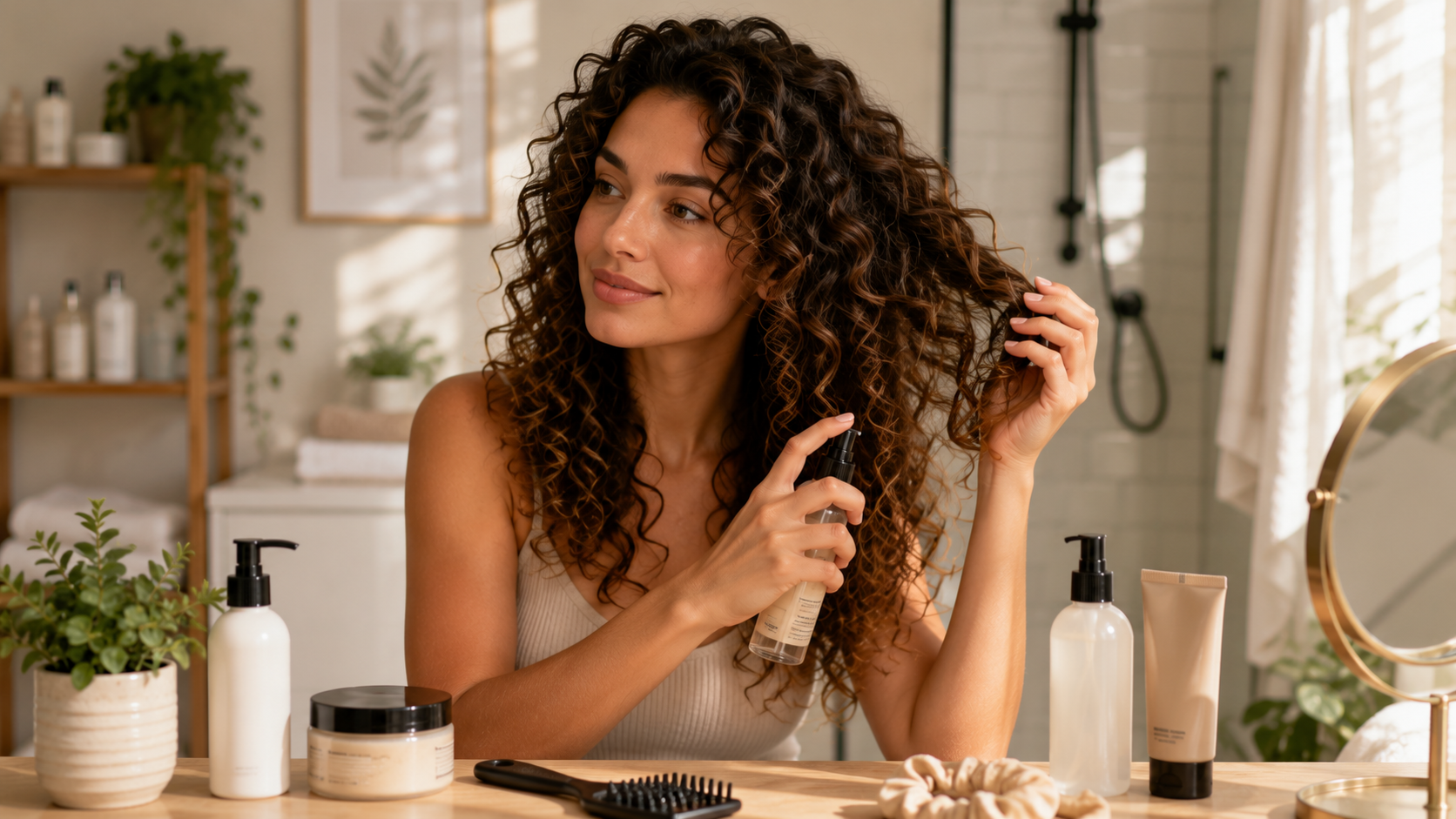
Conditioner is arguably more important than shampoo for curly hair. A rich, moisturising conditioner applied from mid-length to ends after every wash is essential. For tighter curl types, a deep conditioning treatment once a week significantly improves moisture retention and reduces frizz throughout the week. Leave-in conditioner after washing provides ongoing moisture that a rinse-out conditioner alone cannot maintain.
The Refresh Routine Between Washes
Curly hair rarely looks its best on the day after washing because the products have dispersed and the curl pattern has been disrupted by sleep or activity. Rather than washing again, a refresh routine revives the curl pattern without stripping moisture. This is one of the most useful curly hair skills to develop.
A simple refresh involves lightly dampening the hair with water using a spray bottle, distributing a small amount of leave-in conditioner or curl cream through the sections that need it, scrunching gently to reactivate the curl, and allowing it to air dry or using a diffuser on a low heat setting. The water reactivates the styling products still in the hair and the fresh curl cream defines any sections that have lost their shape.
How well refreshing works depends on the products used during the original wash-and-style and how the hair was protected overnight. Well-moisturised curls set with good products and protected during sleep refresh much more easily than dry, poorly conditioned curls.
Protecting Curls Overnight
Sleep is one of the biggest sources of frizz and curl disruption for curly hair. Cotton pillowcases create friction that roughens the cuticle and causes tangles. Hair moving freely around the pillow during sleep disturbs the curl pattern and results in the morning flattened-one-side, frizzy-other-side situation that many curly-haired people know well.
Two straightforward solutions address this. A satin or silk pillowcase dramatically reduces friction against the hair during sleep. Alternatively, loosely gathering the hair into a high pineapple (a soft scrunchie holding all the hair up at the very top of the head) before bed preserves the curl pattern and limits movement overnight. Many people use both: a satin pillowcase and a pineapple for maximum protection.
Using a satin or silk bonnet or hair wrap achieves the same effect and is the most protective option for very tight curl types or for people who move significantly during sleep.
Moisture and Hydration
Moisture is the central concern of curly hair care, and maintaining it between washes requires an active approach rather than passive waiting. The healthy hair year-round principles that apply broadly are amplified for curly hair: regular deep conditioning, protective styling during periods of environmental stress, and avoiding practices that dry the hair out between appointments.
The LOC or LCO method is a popular layering approach for highly porous or dry curl types. LOC stands for Liquid (water or leave-in), Oil, and Cream. Applying products in this order seals moisture into the hair shaft progressively. LCO reverses the cream and oil, which some curl types prefer. Experimenting with both approaches for a few weeks reveals which your particular curl type responds to better.
Heat Styling and Its Impact on Curls
Frequent heat styling is one of the most common reasons curly hair gradually loses its definition and elasticity over time. Heat damage protection for curly hair includes using a heat protectant every single time a diffuser, flat iron, or curling tool is used, keeping temperatures at the lowest effective setting, and limiting direct heat styling to no more than once a week.
A diffuser on a low heat setting is considerably gentler than a standard dryer nozzle or a flat iron, and for curly hair it is the preferred tool when heat drying is needed. The diffuser holds the curl shape during drying rather than blasting it flat. Even with this gentler approach, allowing hair to air dry when possible gives curls the best chance of retaining their elasticity over time.
Trimming and Detangling
Regular trims are important for curly hair because split ends travel up the hair shaft more quickly in textured hair than in straight hair. A split end that is not trimmed can cause the curl to lose its definition as the damaged section frizzes and resists holding its shape. Most curly hair specialists recommend trims every eight to twelve weeks, which aligns well with salon appointment frequency.
Detangling should always be done on wet hair with conditioner or a detangling product providing slip. Starting from the ends and working upward prevents breakage by addressing each tangle without forcing it through the length above. A wide-tooth comb or a detangling brush designed for wet curly hair causes far less breakage than a standard brush applied to dry, tangled curls.
Working with the salon team to identify the specific products and techniques that suit your particular curl pattern gives you a home routine that is an extension of the professional care rather than a departure from it.
Frequently Asked Questions
How often should curly hair be washed?
Once or twice a week is the general recommendation for most curl types. Fine curls that become weighed down easily may tolerate slightly more frequent washing with a gentle cleanser. Thicker, coarser curl types that are naturally very dry often do best with once-a-week washing or co-washing (cleansing with conditioner only) in between.
What is the best way to reduce frizz in curly hair?
Frizz in curly hair is almost always a moisture issue. Hair that is sufficiently hydrated and whose cuticle is sealed with the right products frizzes far less than dry, porous hair. Applying products to soaking wet hair, scrunching in an upward motion rather than rubbing, and using a microfibre towel or t-shirt to dry rather than a standard towel all reduce frizz significantly.
Can I brush curly hair?
Brushing dry curly hair causes breakage and frizz. Detangling should be done on wet, conditioned hair with a wide-tooth comb or a wet detangling brush starting from the ends. Some curl types can use a denman-style brush on wet conditioned hair to define individual curls, but this requires technique and is not suitable for all curl types.
How long should I go between salon visits for curly hair?
Eight to twelve weeks is a common interval for curly hair trims. Some people with very healthy, well-maintained curls stretch to sixteen weeks. Going longer risks split end damage travelling up the hair shaft, which affects curl definition and requires more significant cuts to correct.
What products are essential for curly hair between salon visits?
A sulfate-free shampoo, a rich rinse-out conditioner, a leave-in conditioner, and a curl cream or styling gel are the core products for most curl types. Deep conditioning treatment once a week adds significant moisture for dry or high-porosity curl types. The specific brands and formulations should be chosen based on your curl pattern and porosity.
The Bottom Line
Maintaining curly hair between salon visits comes down to consistent moisture, the right washing frequency and products, overnight protection, and limiting heat use. A good at-home routine makes the results from each salon appointment last longer and genuinely builds the health of the hair over time.
Ross Highland Park's salon team specialises in curly hair care and can recommend the specific products and techniques for your curl type. Stop in or reach out to discuss what would work best for your hair between appointments.