How to Build a Morning Skincare Routine from Scratch
Skincare is one of those areas where the information available massively outpaces the actual complexity of what most people need to do. A decade of beauty content has convinced a significant number of people that an effective morning routine requires eight steps, four serums, and a working knowledge of peptide chemistry. The reality is considerably more approachable. Most people's skin responds very well to a small number of well-chosen products applied in the right order consistently.
Starting from scratch gives you the advantage of building a routine that actually fits your skin type and your life, rather than inheriting a collection of products recommended for someone else's concerns. The most common skincare mistake is complexity rather than simplicity: buying too much, layering too many actives, and then wondering why the skin is not responding well.
Quick Answer: A morning skincare routine from scratch needs four core steps: a gentle cleanser, a moisturiser suited to your skin type, a vitamin C serum if brightening and antioxidant protection are priorities, and a broad-spectrum SPF of at least 30 applied as the final step. Everything else is optional. Get these four right and applied consistently, and your skin will show it within four to six weeks.
Step One: Cleanser
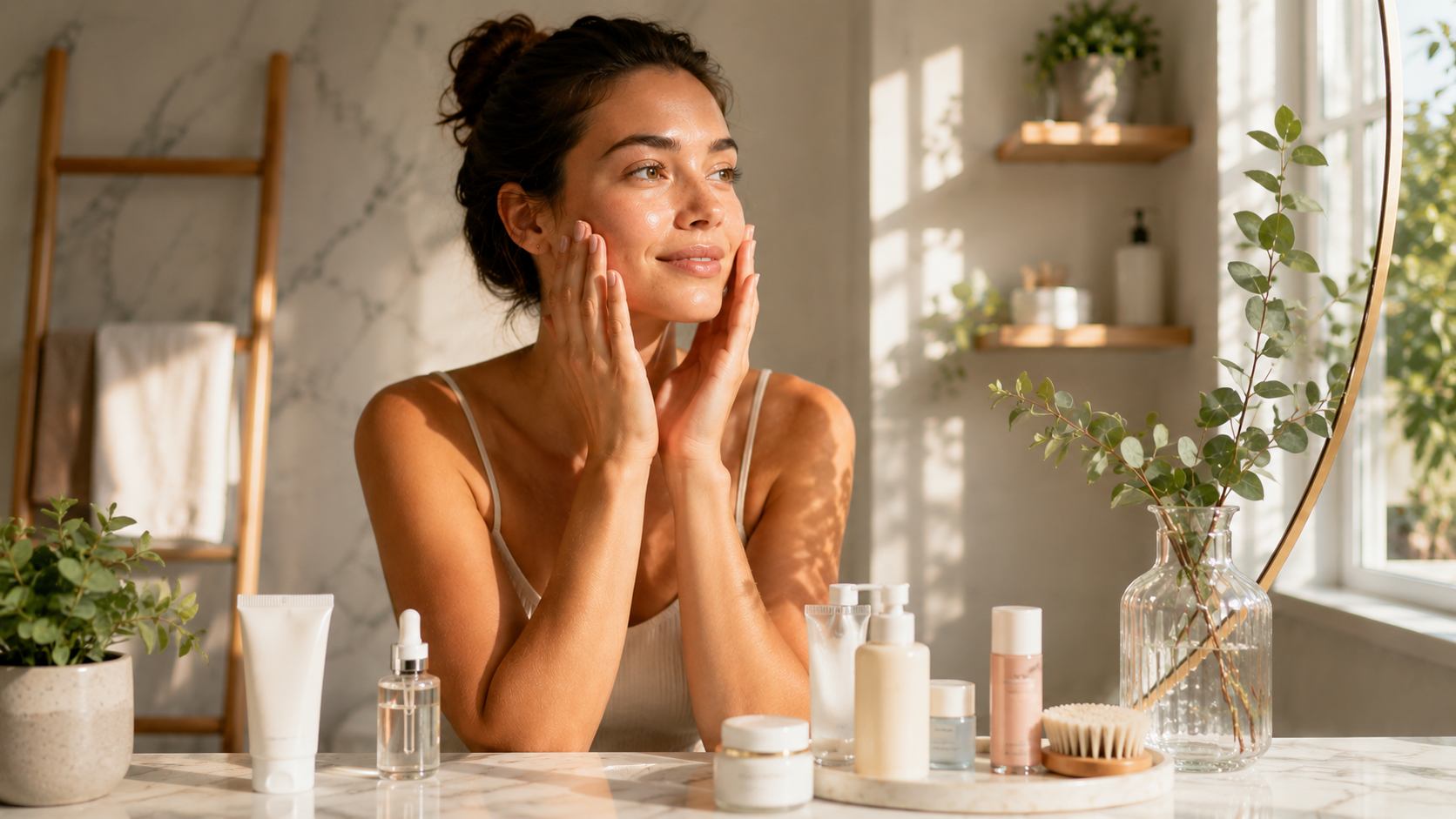
The morning cleanse removes any sweat, oil, and product residue that has accumulated overnight. For most skin types, a gentle, non-stripping cleanser is the right choice: something that leaves the skin feeling clean but not tight or uncomfortable. Gel cleansers work well for oily and combination skin. Cream or milk cleansers suit dry and sensitive skin.
If your skin is genuinely dry, you may find that skipping the morning cleanse in favour of simply rinsing with water is preferable. Overnight the skin does not produce the kind of sebum and dirt buildup that daytime produces, and for dry or sensitised skin, a twice-daily cleanse can strip the barrier unnecessarily. Experiment with this and see how your skin responds.
The most important principle with cleansing is gentleness. Foam cleansers that leave a squeaky-clean feeling are often stripping the skin's natural moisture barrier, which then has to work harder to repair itself. A cleanser that leaves skin feeling comfortable immediately after is doing its job without causing damage.
Step Two: Vitamin C Serum
A vitamin C serum is one of the most evidenced skincare actives available. It provides antioxidant protection against free radical damage from UV and pollution, supports collagen production, and gradually brightens uneven skin tone and fades hyperpigmentation. Applied in the morning before SPF, it provides a second layer of environmental protection that works differently from sunscreen.
Understanding the best skincare ingredients before purchasing a serum prevents wasted money on formulations that are too weak or too unstable to deliver results. A concentration of 10 to 20 percent L-ascorbic acid in a stable, correctly packaged formula is what delivers the clinical outcomes vitamin C is known for.
This step is optional if brightening and antioxidant protection are not priorities for you. If your primary concerns are hydration and basic protection, you can move directly from cleanser to moisturiser. But if uneven skin tone, dullness, or early signs of sun damage are concerns, a vitamin C serum is one of the highest-return investments in a morning routine.
Step Three: Moisturiser
Moisturiser in the morning serves two purposes: it supports the skin barrier and it prepares the surface for SPF application. Even oily skin benefits from moisturiser, because dehydrated oily skin often compensates by producing more oil, which creates a circular problem. The key is finding the right weight and formulation for your skin type.
Oily and combination skin types generally do well with lightweight gel or gel-cream formulations that provide hydration without heaviness. Dry skin needs richer emollient formulas that actively support moisture retention. Sensitive skin benefits from fragrance-free formulas with barrier-supporting ingredients like ceramides, niacinamide, and hyaluronic acid.
Building a routine for your skin type means matching the weight and formulation of your moisturiser to what your skin actually needs rather than defaulting to what a product's marketing suggests is universally appropriate.
Step Four: SPF
Sunscreen is the non-negotiable final step of any morning routine. UV radiation is the primary driver of premature skin ageing, hyperpigmentation, and skin cancer risk, and it is present regardless of whether you are going outside. UV rays penetrate glass, which means indoor exposure during work hours contributes to cumulative damage even if you never step out.
A broad-spectrum SPF of at least 30, applied generously as the last step in your morning routine, provides meaningful protection. SPF 50 is better when prolonged outdoor exposure is expected. The most important thing is choosing a formula you will actually use consistently: a lighter, more cosmetically elegant SPF worn every day outperforms a heavy, uncomfortable one worn occasionally.
Knowing how to properly incorporate SPF into your daily routine includes understanding that SPF should be applied after moisturiser and before any makeup, and that the protection it provides lasts approximately two hours of direct sun exposure before reapplication is needed.
Getting the Order Right
Product layering order matters because it affects how well each product absorbs and functions. The general principle is thinnest to thickest: lighter, water-based products are applied first and heavier, more occlusive products go on top. This is why the order runs cleanser, serum (thinnest), moisturiser (medium), SPF (final layer).
Allowing each layer a moment to absorb before applying the next improves the experience and the results. A minute between serum and moisturiser is usually sufficient. This also helps you notice how each product feels on your skin independently, which makes it easier to identify if a specific product is causing a reaction.
Ross Highland Park carries a curated selection of medical-grade skincare products from brands whose formulations are designed to meet clinical standards, which means the stated active percentages and the ingredient quality are actually what they claim to be, unlike many mass-market alternatives.
Building Consistency Over Optimisation
The biggest predictor of skincare results is not having the most sophisticated routine but having a routine you follow consistently. Four products applied every morning for twelve weeks will produce better results than twelve products applied sporadically. Start simple, get consistent, and add products one at a time if you decide you want to address additional concerns.
Give each new product at least four to six weeks before evaluating whether it is working. Skin cell turnover takes approximately that long, and most actives work over this timescale rather than producing visible results in days. Impatience is the most common reason people cycle through products without ever giving any of them a fair chance to show results.
Frequently Asked Questions
How long does a morning skincare routine need to take?
A four-step morning routine takes between three and five minutes if the products are laid out and ready. The majority of that time is waiting for SPF to dry before applying makeup, if you wear it. Effective skincare does not require significant time investment, which is part of why a simple routine is more sustainable than a complex one.
Should I wash my face in the morning if I have dry skin?
For genuinely dry or sensitised skin, rinsing with lukewarm water rather than using a cleanser in the morning is a reasonable approach. If you have used a retinoid or active treatment overnight, a gentle cleanser to remove any residue is sensible. The goal is not squeaky clean but skin that feels comfortable and prepped for the next steps.
Can I use the same moisturiser morning and night?
Yes, though some people prefer a lighter formula in the morning under SPF and a richer formula at night for deeper overnight hydration. Using the same moisturiser morning and night is a perfectly valid approach, particularly for those starting out who want to keep the routine simple.
Do I need a separate eye cream in my morning routine?
Eye cream is optional. The skin around the eye is thinner and more sensitive, and some people find that their regular moisturiser is too heavy for this area. A dedicated eye cream formulated for the periocular area can address specific concerns like puffiness, dark circles, or fine lines, but it is not a required step in a foundational morning routine.
What should I do if a new product causes redness or irritation?
Stop using the product and give the skin a few days to settle before reintroducing it at a lower frequency. If irritation persists, the product may not suit your skin type or may contain an ingredient you react to. Patch testing a new product on the inner arm for a few days before applying it to the face is a sensible precaution.
The Bottom Line
A morning skincare routine from scratch needs four steps: cleanser, vitamin C serum, moisturiser, and SPF. Consistency with these basics over weeks and months produces better results than a more elaborate routine applied intermittently.
Ross Highland Park carries a carefully selected range of skincare products for every skin type and concern. Stop in or browse the skincare selection to find the right products for your morning routine.